Once upon a time, we didn’t have devices to tell us everything. We had almost nothing at all, except our eyes which told us what we saw, and our ears that told us what we heard. And a lot of the latter wasn’t always worth remembering, because you know what it’s like when a story passes through five sets of ears and five mouths, it becomes unrecognizable from the original. No one wants to be a boring storyteller. Legend has it that a lot of knowledge was passed down in this way, older people relaying stories of days gone by to rapt youth, but come on, surely a lot of it had to be embellished beyond recognition. Grandpa Simpson is funny for a reason.
You could only really trust what you saw and could confirm. Information was scarce and communication was difficult.
Then came books, which became truly useful as information sources when the general public, or the ‘lower classes’, learned to read. Scoff if you will, but it was not that long ago in the big scheme of things when that shift actually happened, that schooling became widespread. It still isn’t in some cultures. But anyway, not here to dissect or critique those that live very far from me in uncomfortable circumstances. It took a while for books to increase real education as well; up until maybe 70 years ago, books provided a very limited view of the world. Check out a 1960s vintage Encyclopedia Britannica if you ever get a chance, which was the gold standard of learnin’ in the day, and look up, say, Uruguay, and you’ll find basic facts about the geography, and what it produced, and maybe two or three black and white pictures of primitive scenes that framed all you would ever know about Uruguay.
Until the internet came along. Then you could know everything about Uruguay, and every other place as well. Now there are webcams all over the place, documenting everything. Or people with cell phones and excellent internet connections. For a pleasant decade or so, that remarkable combination opened up the world to everyone in a remarkable way.
The information age brought us a total rethink of how information is disseminated. I can’t speak of other industries, but in the energy industry the ‘new world’ came into focus sharply and rapidly. Think back a few decades ago to when oil spills caught global headlines. The existing information infrastructure dictated that updates on an incident were provided via press releases, whereby as information was known, it was disseminated. But things weren’t ‘known’ with any degree of certainty until far down the road. If there was a pipeline leak into a creek (you know who), the pipeline operator needed time to first determine that it was the source of the leak, then to pinpoint the location, then to ascertain how much had leaked. That was a logical and sound process of discovery, but it didn’t work very well anymore. The problem was that, with the advent of cell phones with cameras, some farmer or hunter or hiker would happen upon an oil-soaked duck, take a pic and upload it, and within minutes the whole world knew that something had happened, far before the company had any chance whatsoever to make intelligent comment on it. The company may not have been aware of a spill at all, but the whole world was.
That phenomenon ushered in a new era of trust, in one way, because institutions could no longer just say what they felt like, secure in the knowledge that no one could ever know the reality. When everyone can document everything at any time, there is nowhere to hide.
As a result, we enjoyed a brief moment in time whereby information about significant events could be captured and relayed to the world in near real-time, from anywhere, by anyone.
But then of course, being humans, we couldn’t leave well enough alone, and someone had to pee in the well. The art of disinformation
Bad actors now stir the pot for no other reason than to sow chaos and disharmony. Go ahead, post anything political on social media, either for or against a certain party. Once and you might go unnoticed; do it ten times and out of the woodwork they come, unbounded by truth or humanity, their only purpose to enrage you. The algorithm smells the blood and inserts the mess into more people’s feeds, attracting more venomous bots and more earnest people that fall into the trap of trying to make bring rationality to the discussion. They are wasting their time. There is no rationality, on purpose, and there never will be. The bots flit in with their incendiary contribution then move on to the next.
The bots come in various species. Some are just hateful people that like to annoy others. Some are pros, working for organizations or governments to sow discord. Russia was recently caught red handed when they hired various dull-witted goons to mobilize a ‘sabotage and provocation campaign’ by “creating fake online far right and Muslim groups, which were used to organize acts of vandalism in the UK and stir up division and fear.”. It’s not just Russians, although they are highlighted here because their strategic cunning is so lamentably funny that it deserves attention (one of the hired dipsticks was tasked with torching Keir Starmer’s house and/or vehicles; the sly fox first burned a Toyota (that was previously owned by the prime minister), then set alight a flat (where Starmer used to live), then lit another residence (that was indeed Starmer’s but had ben rented to his sister-in-law). The Russian mastermind was no better, a 23-year-old son of a European diplomat who created various phony entities, manipulated them through social media accounts that were obviously of Russian origin, and even advertised for renegades to paint hate messages for money.
As dopey as these knuckleheads sound, what they do is tragically effective. How does disinformation destroy? By pitting otherwise good people against each other. “Hey, that guy just called you a jerk.” That’s all it takes for some people to lose their minds, no matter if there is any truth to it. It is sad but heartening to watch children learn to navigate this sort of thing; it makes you want to bawl to realize that the tactic works as well or better amongst adults. The architects of bad blood prey on human weaknesses, or sense of justice and grievance: Find a target audience that is easily enflamed, then pour gas on the fire. Turn annoyances into hatred.
It’s so easy to do. It is lazy but effective, and tragic – because what is destroyed is not the political opponent, but trust.
Which brings us back to the double edged sword of the information age, that the truth can now be seen and analyzed, but if we let our lazy eyes only be guided by the most accessible forms of information, we won’t be getting the whole picture, and everyone now realizes this, which is why trust in the media has crashed. And then people retreat to their own echo chambers, where they may have a sneaking suspicion that they are hearing untrue things, but because they are untrue things they feel philosophically aligned with, they feel better. There are great and valid information sources; such as trade publications, where boots on the ground or industry insider types provide context into real world realities that can only be known by living in that space. From these vantage points one can see that mainstream stories only tell part of the story, and that that part of the story they see is carefully curated for a purpose that is not 100 percent clarity.
It’s not that media is always problematic; they have the same problem as operators trying to figure out what went wrong before commenting. They don’t want to look stupid with premature speculation. The story behind the incident would take time to reveal itself as official sources understandably waited to avoid speculation, but in the meantime…we all saw the black oil-coated duck.
Ah, but those were the good old days, 15 years ago, when the black oil-coated duck was just a black oil-coated duck. Now, with a few clicks, a black oil-coated duck can drive a car on the freeway or play Jimi Hendrix’ Purple Haze, in incredibly life-like video. AI is bending reality before our eyes, improving week by week. Soon, video evidence will be worthless, the fakes are great already and will only get better.
Where will that leave us in five or ten years? Robotic assistants doing all the manual labour like cleaning your house or building houses or being nursemaids, while we sit around watching even more addictive fake entertainment? Possibly. It is hard to say.
It is hard to imagine how trust in anything will increase, but there will be several bedrock foundations we can count on happening no matter what. Human interaction will become more vital, because we can judge for ourselves that it is real. Same with interactions with the natural world. Maybe the authenticity of both human and natural grounding will become as valuable as screen time.
The other thing that is inevitable is the demand for energy to power it all. As hard as it is to believe after the last decade of energy animosity, conventional energy providers are now being recognized as the cornerstones of it all, even in the most unlikely places. Consider the recent statement by the G7, which is remarkable, particularly in comparison to that of a few years ago. In 2023, the final group statement had an entire section on climate change and energy, with primitive language characteristic of the era: “While acknowledging various pathways according to each country’s energy situation, industrial and social structures and geographical conditions, we reiterate that these should lead to our common goal of net zero by 2050 at the latest…[we] support a global tripling of renewable energy capacity…hand in hand with accelerating the phase out of unabated fossil fuels.” There are four full paragraphs of this stuff.
In 2026, a scant three years later, here is the entire unabridged G7 statement on energy (no mention of climate whatsoever): “We commit to accelerate the diversification of energy supply routes in order to reduce global vulnerability to the Strait of Hormuz and to increase our energy stocks. We welcome the potential for Canada to deliver significant additional capacity to global markets in the coming years.”
Does everyone realize how insane that is? That sort of change in three years? From accelerating the phase out of fossil fuels in 2023 to “Canada, produce more of them, asap, with no qualifications, and get on it would ya.” Canada! Singled out! Of all places, home to the baby-killing oil sands, from which much of this new desired growth will emanate. 2023’s musings were the result of some hallucinatory drug that was just starting to wear off, and now it has. Completely. It’s so crazy you’d think AI had a hand in that somehow, but it didn’t.
Oh wait, yes it did. Indirectly. AI is going to gobble up energy here, there and everywhere. It doesn’t care about the source, but it does care about ‘five nines’ reliability and you can do the math on that yourself about where it will come from. In a few years or decades, it will be fusion or nuclear or potentially some other breakthrough, but here and now, it’s going to come from all those guys in coveralls manning the rigs.
Behind this year’s G7 statement is the inevitable bounce back from 2023’s nuttiness: Energy security trumps everything; that is a non-partisan fact unrelated to where energy comes from. People want the best source for the job, and the G7 now acknowledges what that is.
In a few years, we might trust very little, but we will trust some things. Metals, minerals, energy, food, friends, coffee shops, pubs…real things are going to become more important.
It is a paradox that seems unsolvable; highly complex energy systems that absolutely must function near flawlessly will require public trust and coordination. Or, if not coordination, at least respect. It isn’t hard to see how devastating small actions can be if aimed at harming infrastructure, as we are seeing in Ukraine and Russia, where vulnerable supply nodes can be attacked with great effect, something I learned as a youth when my brother and I would throw rocks at the glass insulators on power poles alongside the farm for the boyish stupid joy of seeing them explode until one day my dad caught us and as his face turned pale he explained the potential consequences of what we were doing. That was a bad day.
But we are faced with that problem in this divided and growingly fake environment, whereby we have to trust information that we can’t personally verify, and we don’t know who to trust. We used to know if we had enough firewood for a winter, now we have to trust that the pipeline will bring gas until spring.
The danger here is obvious; if the bad actors like the Russian agents of chaos noted above decide to undermine trust in energy systems, we will be in big trouble. We had a taste of it five years ago, when kids took time off from school to go scream in the streets with little signs that the fuel that kept them alive was killing them. The whole purpose then was to undermine trust in the existing energy system, but it was such a clumsy and ill-conceived attempt that, despite a lot of lip service, the public saw right through it. The next wave of attacks might be vastly cleverer and more effective.
We need new solutions for trust, in everything: politics, media, news, what we watch and what we hear. It is going to get worse before it can possibly get better. But there is hope, in that our human side will steadfastly insist on some form of authenticity even if every sign says it won’t happen. Remember the Covid years, when no one could go anywhere, and malls were deserted, and everyone began shopping online, and a general consensus emerged that malls were dead forever because online shopping was just infinitely easier. Yeah, well, how did that work out, try going to any mall on a Saturday afternoon these days and you’d never believe the social calamity that happened just six years ago.
Who knows, all that is for certain is that it is going to be interesting.
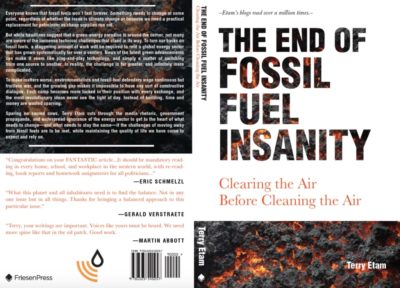
At the peak of the energy wars, The End of Fossil Fuel Insanity challenged the narrative of imminent fossil fuel demise, facing into the storm. And now everyone is coming around to this realization as well. Read the energy story for those that don’t live in the energy world, but want to find out. And laugh. Available at Amazon.ca, Indigo.ca, or Amazon.com.
Email Terry here. (His personal energy site, Public Energy Number One, is on hiatus until there are more hours in the day.)