The perception of many outside the industry is that what is being done to prevent pipeline leaks from occurring is not good enough. A few unfortunate high-profile incidents and the resulting media coverage have drawn negative attention and scrutiny which is taken out of context against the good work and progress being made by the industry as a whole.
The reality is companies recognize the importance of having a solid integrity program, and are doing the best they can to mitigate risk using the tools they have at their disposal. They are constantly striving to become more fiscally and environmentally responsible, and to improve outcomes wherever possible. The problem is not a lack of desire or hard work required to do better…it’s a lack of innovative solutions to enable improvement. The challenge, then, is first to take a critical look at the tools and processes available in the market today, and second, to ask ourselves how we can make them better.
Traditionally, pipeline integrity programs have begun with a risk assessment calculated using algorithms to determine a prioritized list of pipelines requiring attention. A field-based program is then deployed based on these priorities as a means of mitigating risk. The problem is that the program is only as good as the information used to create it. And, today there is a fundamental gap between access to information and execution in the field.
Information about operating conditions of assets may be stored in multiple locations with no way of bringing the data together. Critical records collected from historical inspections are often trapped in spreadsheets, inaccessible on someone’s computer, or isolated in a filing cabinet. Without integration of various information sources, we are perpetuating the same problems, year after year, with no obvious path to improvement.
The Challenge with Water Crossings
Water crossings have also presented some unique challenges as part of an overall pipeline integrity plan, starting with the fact that the definitions of what constitutes a water crossing and how often a crossing should be inspected are open to interpretation. Also, the traditional approach of identifying the size of a water body based on map scale is somewhat subjective. And, while best efforts are being made by companies to manage crossings, it becomes increasingly difficult when simply identifying crossing inventory is problematic.
With the potential for high impact to environmentally sensitive areas, wildlife and downstream communities if there is an event, crossings require focus and attention. Leak detection practices are getting better, but when it comes to water crossings, it’s still not enough to find out after-the-fact. We need to concentrate on decreasing the likelihood of an event occurring in the first place. This means more than just managing corrosion…it also includes assessment of geotechnical issues which have the potential to impact adjacent pipeline infrastructure.
The truth is that unless we make some changes, the problem will continue to grow.
- At present, 74% of pipelines built before 1990 and 64% of pipelines built between 1990 and 2000 are still operational, introducing vulnerabilities due to aging infrastructure.
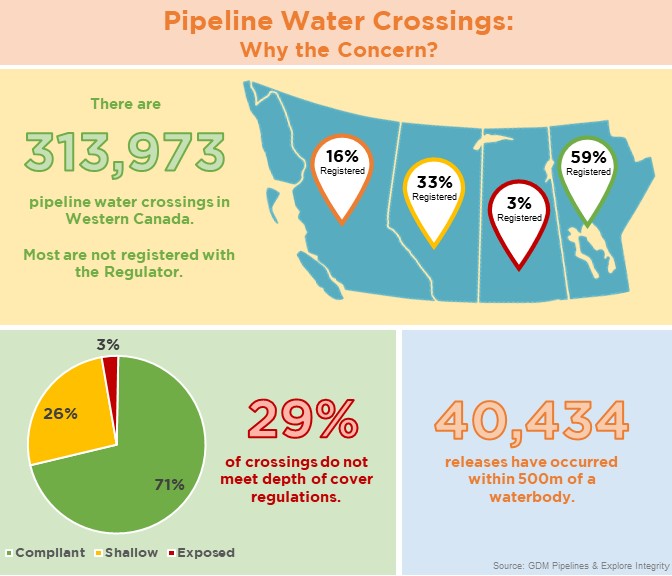
- There are more than 313,000 water crossings in Western Canada, yet only about 26% of these are currently registered with the respective regulating bodies.
- Over the past 30 years, there have been over 40,000 releases that occurred within 500 m of a water body in Western Canada.
Based on an assessment of close to 5,000 crossings, 29% did not meet the requirement for 1.2m depth of cover, and of these, 3% were completely exposed.
So, Where Do We Go from Here?
The good news is that the recent release of gX Insight by GDM Pipelines and Explore Integrity has brought a new approach to overall integrity management. By delivering integration between information and execution, users now have a single point of access for best-in-class, complete integrity management. This unified solution delivers the new tools and processes that the industry has been craving.
For crossings, this means taking much of the guess-work out of creating and maintaining a water crossing program. It begins by easily identifying your pipeline water crossings and applying a calculated priority algorithm based on Explore Integrity’s 17,000+ historical water crossing inspections. It also incorporates a scientific approach to determining the size and impact to water bodies through a comprehensive hydrology network calculation, which not only enables users to focus resources, but also delivers proactive notifications of high water events that may impact infrastructure. Overall, users will be able to streamline processes and increase the effectiveness of their water crossing programs through a single integrated solution.
To learn more about this new approach to integrity management, especially as it relates to pipeline water crossing management, GDM Pipelines and Explore Integrity invite you to attend an informative presentation to dig deeper into the innovative new best practices that are being delivered through our joint solution, gX Insight.