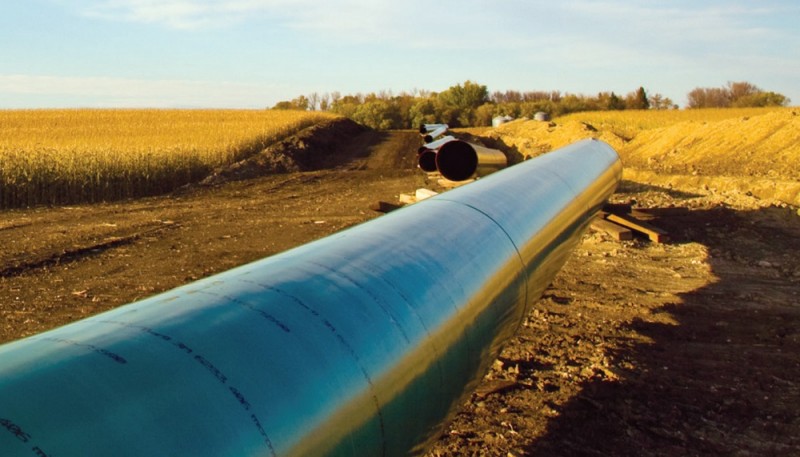
CALGARY – Delayed oil pipeline construction is causing a steep discount for Canadian crude prices that is costing the economy roughly $15.6 billion a year, according to Scotiabank.
“Pipeline approval delays have imposed clear, demonstrable and substantial economic costs on the Canadian economy,” said bank chief economist Jean-Francois Perrault in a report Tuesday.
The discount, however, is expected to ease through the year as more rail capacity becomes available to ship oil, bringing the expected cost to roughly $10.7 billion or 0.5 per cent of GDP for 2018 and then to $7 billion or 0.3 per cent of GDP a year until more pipeline capacity comes online.
The costs of the discount are increasing as delays continue for all three major proposed oil pipelines to export more oil from Western Canada, including Kinder Morgan’s Trans Mountain expansion, Enbridge’s Line 3 replacement, and TransCanada’s Keystone XL.
Canadian producers would need Line 3 and at least one of the other pipelines to go forward or face indefinite pipeline constraints that would have an impact on Canada’s well-being with consequences that extend well beyond Alberta, said Perrault.
“The elevated discounts come with a steep economic cost, and represent to a large degree a self-inflicted wound,” he said.
The latest economic impacts of the pipeline constraints come amid an intensifying spat between Alberta and British Columbia over the construction of the Trans Mountain project, pitting arguments of economic impact against the importance of protecting coastlines and limiting greenhouse gas emissions.
The potential climate change impacts from increased oilsands production should also be factored into any calculus, said Greenpeace’s Keith Stewart, in an email.
“Climate change also imposes clear, demonstrable and substantial economic costs on the Canadian economy, and those costs are only going to get worse.
“To safeguard our kids’ future, we should be asking how we can prosper as we move beyond oil rather than adopting the banks’ myopic focus on how to maximize the next quarter’s profit margin.”
The current squeeze in pipeline capacity has been expected for some time, but the leak and temporary shutdown on TransCanada’s Keystone pipeline last November sped up the problem, said Perrault.
The shutdown led to oil storage tanks in Alberta to fill to record volumes and sent the spread between Western Canadian and U.S. crude to more than US$30 a barrel, while the regulator-imposed 20 per cent reduced capacity on Keystone has continued to limit a recovery.
The discount on Western Canadian oil production since the spill has hovered around US$24 a barrel, much higher than the US$13 spread for the past two years, and Scotiabank expects it to average US$21.6 a barrel for 2018.
Companies in the oil sector have been raising concerns about the wide spread on prices, with Cenovus CEO Alex Pourbaix saying last week that it’s having an extraordinary impact on the Canadian economy and amounts to a transfer of wealth from Alberta and Canada to U.S. refiners and consumers.
Western Canadian production is discounted somewhat both by quality and transportation costs, but has spiked several times in the past decade as pipeline space runs tight.