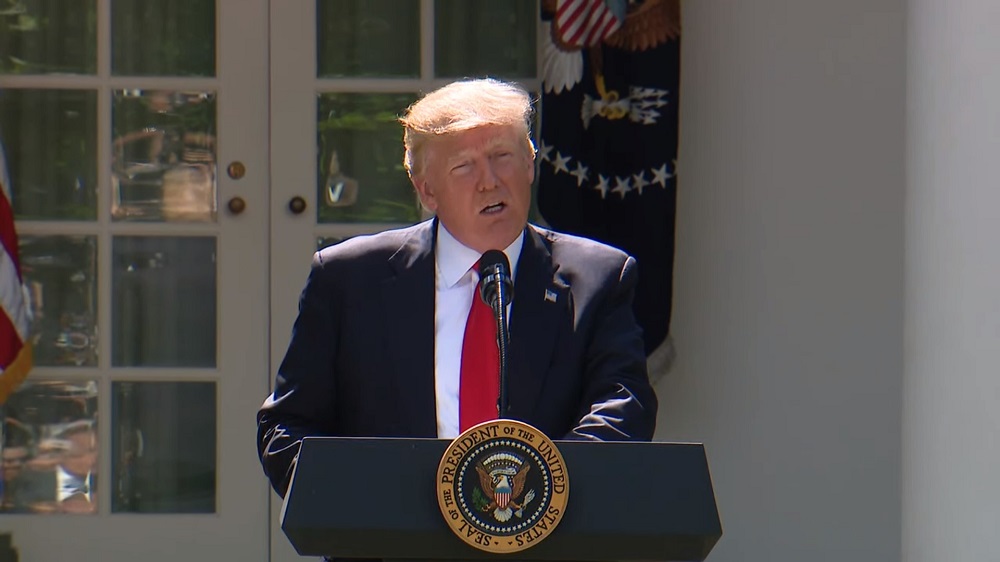
 Global stocks fell on Friday after U.S. President Donald Trump intensified his tariff war against Canada, leaving Europe squarely in the firing line, sparking a modest investor push into safe havens such as gold.
The Canadian dollar fell after Trump issued a letter late on Thursday that said a 35% tariff rate on all imports from Canada would apply from August 1. The European Union was set to receive a letter by Friday.
The U.S. president, whose global wave of tariffs has upended businesses and policymaking, floated a blanket 15% or 20% tariff rate on other countries, a step up from the current 10% baseline rate. This week he surprised Brazil, which has a trade surplus with the United States, with duties of 50%, and hit copper, pharmaceuticals and semiconductor chips.
Aside from pockets of volatility in target currencies, stocks or commodities, markets have offered little in the way of reaction to the onslaught, leaving the VIX volatility index at its lowest since late February.
In Europe, the STOXX 600, which has risen 2% this week, fell 0.8%. Futures on the S&P 500 and the Nasdaq fell 0.4-0.5%, pointing to a retreat from this week’s record highs at the open later.
“The market is becoming a bit numb to these (tariff) announcements, and perhaps it’s not until we see hard data showing an impact that we (will) start to see the market reacting,” City Index strategist Fiona Cincotta said.
“Obviously, we’re getting more information through that does bring with it an element of clarity. Because there is so much uncertainty, there is still this idea that Trump could be open to negotiation, nothing feels ‘final’ still,” she said.
The dollar rose as much as 0.5% earlier against the Canadian dollar before retreating to C$1.3697, up 0.2% on the day. The euro, which has lost nearly 1% in value since the start of July, was down 0.1% at $1.1694.
Earlier in the week, Trump pushed back his tariff deadline of July 9 to August 1 for many trading partners to allow more time for negotiations, but broadened his trade war, setting new rates for a number of countries, including allies Japan and South Korea, along with a 50% tariff on copper.
Joseph Capurso, head of international economics at the Commonwealth Bank of Australia, said the tariff rate of 35% on Canada was not as bad as feared because most of the imports are still subject to exemptions under the United States-Mexico-Canada Agreement (USMCA).
“Now the tariff rate on imports from the EU… That’s what we don’t know as yet,” Capurso said. “If you get something similar to (the U.S.-China trade war in April), that’s going to be very destabilising.”
Wall Street indexes posted record closing highs on Thursday as AI chip maker Nvidia made history, bagging a market valuation above $4 trillion.
Gold rose for a third day in a row, up 0.8% to $3,348 an ounce, bringing gains for July so far to 1.2%. Treasuries got less of a safe-haven boost, as investor concern about the fragility of long-term U.S. government finances prompted a selloff that pushed yields up.
Benchmark 10-year yields rose 3.7 basis points to 4.384%, adding to Thursday’s rise on the back of data that showed jobless claims unexpectedly fell last week.
The yen, which also typically behaves like a safe haven, has been steadily weakening as the prospects dim for a U.S.-Japan trade deal. The dollar was up 0.45% on Friday at 146.93 yen, set for a weekly gain of 1.6%, the biggest this year.
Bitcoin rose as much as 4.6% to a new record of $118,832.
Investors will be watching second-quarter corporate earnings next week to gauge the impact of Trump’s tariffs from April 2. JPMorgan Chase is due to release results on Tuesday, essentially kicking off the reporting period.
Oil prices rose nearly 1%, partially reversing the previous day’s losses, to leave Brent crude at $69.3 a barrel.
(Reporting by Stella Qiu in Sydney. Editing by Saad Sayeed and Mark Potter)