Resilience in an Unpredictable World
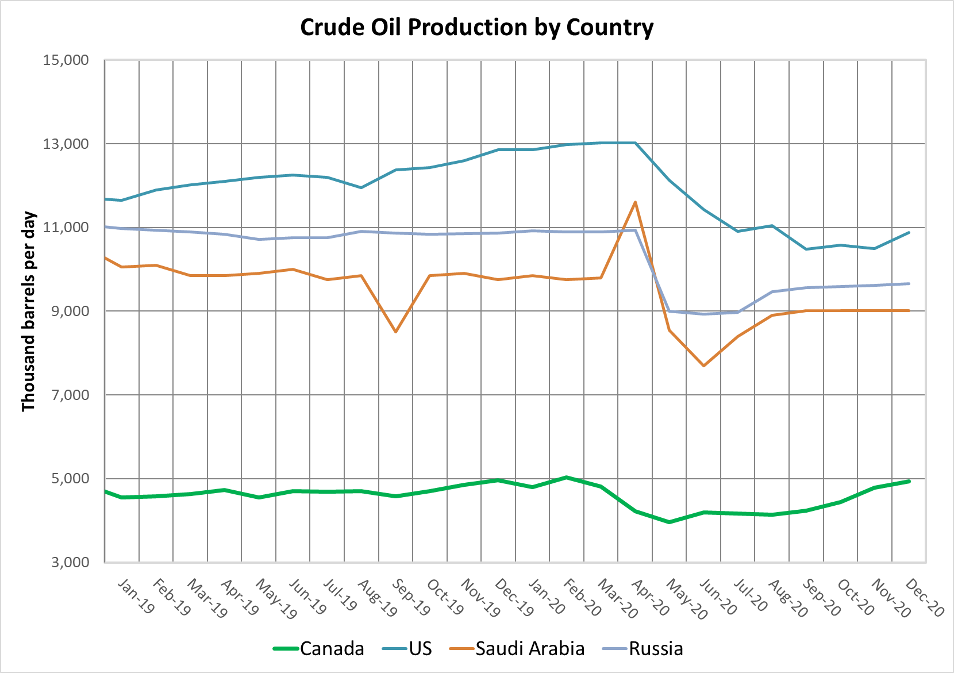
Unprecedented demand destruction has upended the oil market throughout the past year. As a result, oil production has dropped in the three largest oil-producing countries: The United States, Russia, and Saudi Arabia. How has Canada, the fourth-largest producer, been able to buck the trend by quickly restoring production and increasing global market share?
Data Sources: U.S. Energy Information Administration, Canada Energy Regulator
Throughout a year of unprecedented setbacks (Covid-19 and related economic shutdowns, an OPEC+ price war, and the cancellation of Keystone XL) Canadian oil producers have successfully responded to market conditions while managing to avoid significant long-term reductions in production. As governments around the globe struggle to fully re-open economies safely, Canadian crude production is at near-record volumes. This puts Canadian producers in a position to benefit from increasing oil prices.
The Development Treadmill
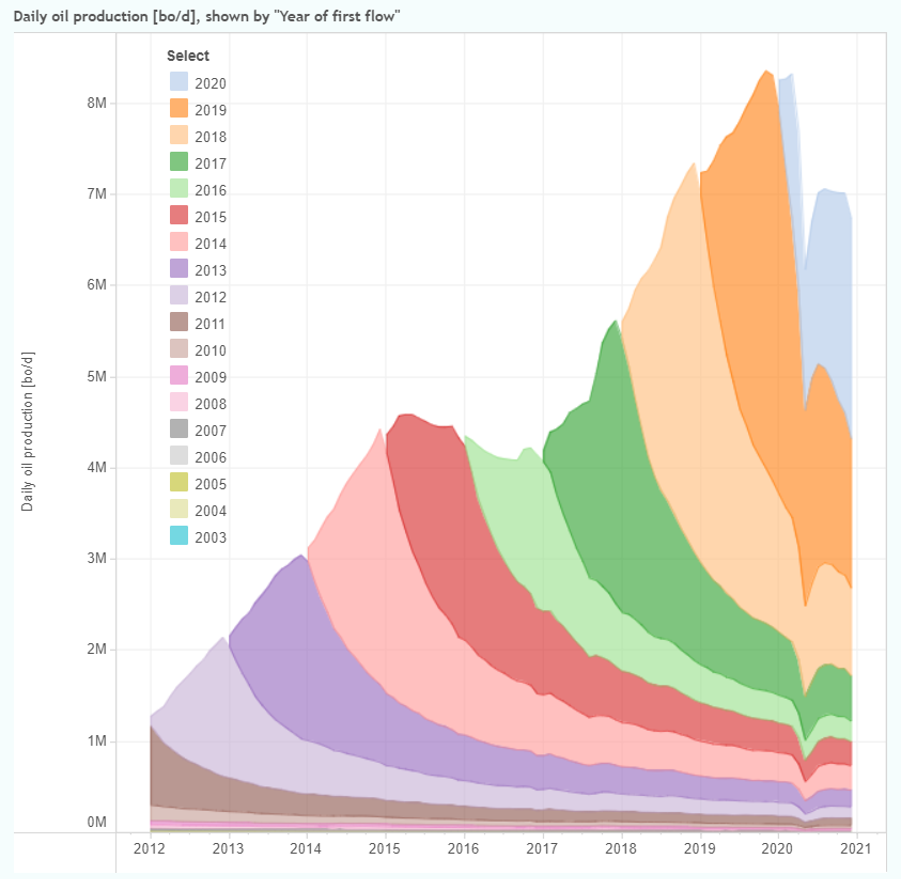
Canadian oil sands mining and SAGD operations, which make up a significant portion of total Canadian oil production, are designed to produce at a relatively consistent rate over a long period of time (years/decades). This is in contrast to the steeply declining production profile characteristics typical of U.S. shale wells. Without significant ongoing capital investment to continually drill new wells, production from shale fields drops off quickly.
US Onshore Tight Oil Production by On Production Year (Excluding West Virginia)
Source: ShaleProfile.com
To what extent will U.S. tight oil drilling activity respond to higher prices? Public companies are likely to remain more disciplined but private company activity is picking up. OPEC+ is certainly keeping a close eye on development activity. What seems clear, however, is that development will be less responsive to increasing oil prices than in the recent past.
Efficiency at Scale
In 2020, the structure of operating costs had a significant impact on how producers responded to lower prices. Canadian oil sands mining and SAGD operations have significant fixed operating costs. Scaling down operations can result in worse economic outcomes because fixed costs are spread over fewer barrels. Once oil prices were high enough to meet minimum project economics, it made sense for most operations to return to full production. These economic incentives limited the size and duration of production cutbacks.
One Big Customer
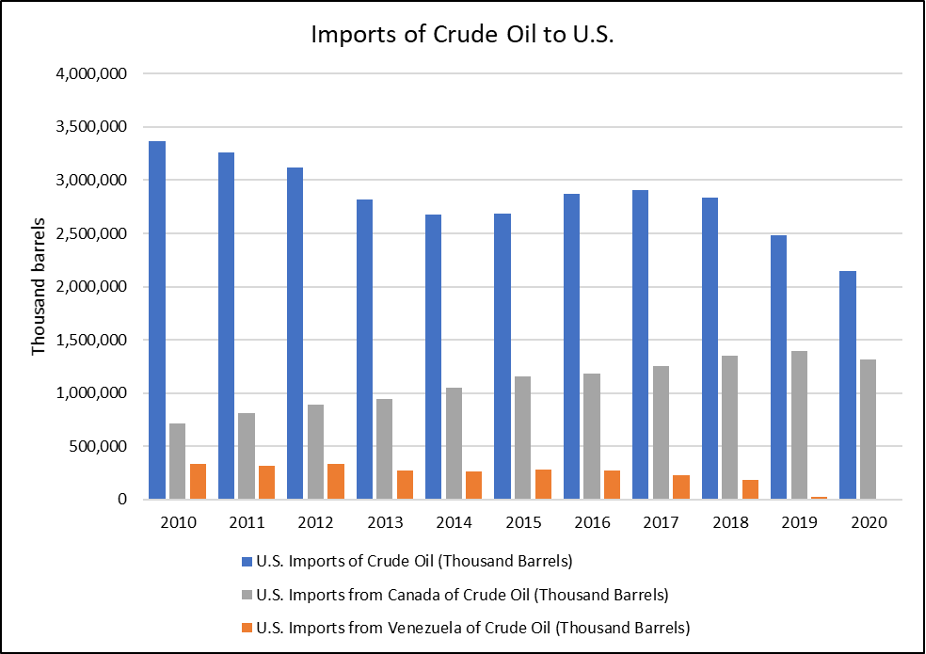
Total U.S. oil consumption dropped by approximately 12% between 2019 and 2020 while total crude oil exports from Canada experienced a much smaller drop of 5%.
Data Source: U.S. Energy Information Administration
Canadian crude, dominated by heavy crude grades, is the feedstock of choice at many U.S. refineries. The economic incentive for refiners to process heavier crude grades has persisted over the turbulence of the past year and is expected to continue into the future.
U.S. imports of Canadian crude have steadily increased over the last decade, and bilateral energy links between Canada and the United States remain resilient. This is despite lower total U.S. imported volumes and ongoing scrutiny of new and existing pipelines. The regulatory and legal issues that have made it extremely difficult to build new oil transportation links does not only limit Canadian crude access to other customers; it also limits the displacement of Canadian crude in the U.S. market. Canadian crude has also benefited from the elimination of heavy crude imports sourced from Venezuela.
Positioned to Profit from Higher Prices
Canadian producers are well-positioned to benefit from higher prices as vaccination rates continue to increase, fiscal stimulus makes its way into consumers’ pockets, and sunny weather signals the start of the driving season.
For commodity price forecasts and more information on GLJ’s products and services, please visit www.gljpc.com.
By John Cowie, Senior Engineer, GLJ Ltd.
GLJ Ltd is a leading energy resource consulting firm. With comprehensive industry expertise and client-focused philosophy, GLJ provides technical excellence to a global client base. The company’s long-term record of success comes from an experienced team of professionals who have an absolute commitment to delivering high-quality results for their clients.