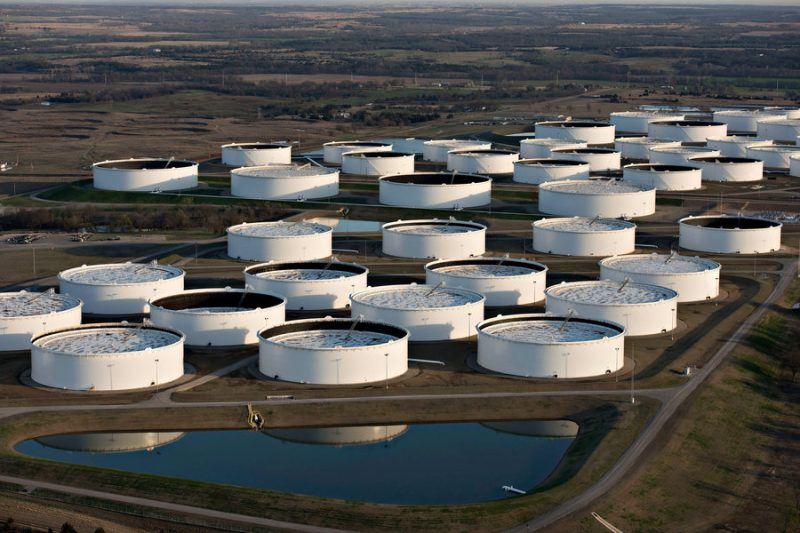
 Oil supplies are set to tighten further in coming weeks even if the U.S. and Iran agree on a peace deal to end their war because it will take weeks for oil shipments to resume from the Middle East Gulf and reach refiners worldwide – so oil companies will continue to deplete storage tanks to meet peak summer demand.
The world has used temporary buffers – commercial stockpiles, oil in transit or held in storage at sea and emergency reserves – to offset the shock from the war in the Middle East. The full impact of the disruption to oil supplies has yet to wash through markets and the global economy because it will be many months before Middle East production and exports return to pre-war levels, said executives from major energy companies, investment banks and market analysts.
The rapid depletion of commercial stockpiles and emergency reserves has come at a time when stockpiles typically build as refiners and retailers prepare for peak demand during the Northern Hemisphere summer. The global energy system will soon enter peak demand in a weakened position to deal with the spike in consumption from summer driving, aviation, farming and freight.
That would stress the global energy system and extend the time it would take for oil producers and refiners to relieve supply shortages and for high fuel prices to return to pre-war levels, according to executives and analysts. “Even if the conflict, and I hope so, will end in the month of May, we would exit the conflict with clearly some very low inventories,” TotalEnergies CEO Patrick Pouyanne said last week, estimating global hydrocarbon stock draws of 10 million to 13 million barrels per day have resulted in at least 500 million barrels already consumed from stockpiles.
For comparison, the U.S. has about 460 million barrels in crude inventories. Equinor CEO Anders Opedal said on Wednesday that it would take at least six months for the market to get back to normal, even with peace in the Middle East.
‘UNPRECEDENTED DISRUPTION’
U.S. President Donald Trump has said that prices would drop quickly once the conflict is over. Progress on talks between the U.S. and Iran on a framework peace deal led to a fall of 7.8% on benchmark Brent crude futures on Wednesday to $101.27 a barrel. While oil futures would likely fall quickly in the event of a deal, it would be some time before physical crude and gasoline prices fall to pre-war levels as supplies recover from one of the biggest supply disruptions in history. Analysts have steadily raised their forecasts this year, and a Reuters poll last week had them pegging Brent futures to average $86.38 a barrel this year, up from around $62 a barrel in January.
Demand is likely to run higher once the conflict is over as countries and companies worldwide look to rebuild stockpiles and restart shut-in production facilities – and some countries that have suffered shortages start building new stockpiles. Australia, which imports roughly 80% of its fuel and has experienced shortages since the start of the conflict, announced plans on Wednesday to spend $7.22 billion to build up fuel reserves. The European Commission said last month it would consider reviewing the EU’s requirement for countries to hold at least 90 days of oil stocks, to include a specific jet fuel requirement. Since late February, when the war began, stockpiles have fallen quickly. Global inventories are expected to drop to around 98 days of demand by the end of May from 101 days currently and from 105 days at the end of February, Goldman Sachs said this week, warning that refined product buffers are “approaching very low levels fast.”
So far the world has lost around 600 million barrels of oil supply, according to Rystad Energy. By the time supply returns to normal, assuming normalization of shipping starts at the end of May, the world will have lost 1.2 billion to 2.0 billion barrels of supply, equivalent to between 16-27% of pre-war global inventories, said Claudio Galimberti, chief economist at Rystad Energy.
Global gas supplies have also taken a big hit due to the closure of Qatar’s liquefied natural gas (LNG) production and damage sustained during the war. The loss of supply will total between 30 million tonnes and 50 million tonnes of LNG, equivalent to between 7%-11% of annual global supply, Galimberti said.
“It’s obvious to most that if you look at the unprecedented disruption in the world supply of oil and natural gas, the market hasn’t seen the full impact of that yet,” Exxon Mobil’s CEO Darren Woods said in an analyst call last week.
U.S. gasoline inventorieswould fall to around 198 million barrels by late summer – the lowest level for that time of year in modern records, Morgan Stanley predicted. U.S. gasoline stocks were just under 220 million barrels on May 1, the lowest for this time of year since 2014, government data showed. Rising exports to meet demand from countries experiencing shortages have accelerated the drawdown.
Europe could face jet fuel shortages as early as June if disrupted Middle East supplies are not fully replaced, the International Energy Agency has warned.
Ireland had just 10 days of stock cover for jet fuel supplies, according to a note from Goldman Sachs published last week. In Asia, crude imports fell 30% in April from a year earlier to the lowest since 2015, according to Kpler, underscoring the extent of supply disruption in the world’s largest oil-consuming region. Onshore fuel oil inventories in Singapore, a major bunker hub, fell to a near one-year low in the week to April 29, as both imports and exports declined, data showed last week.
A SLOW RECOVERY
Even if supply routes reopen, the global energy system will not recover quickly, executives and analysts said.
Woods said it would take one to two months for oil flows to normalise after the Strait of Hormuz reopens, as shipping backlogs clear. It takes on average 30 days for ships to move from the Middle East to the European Union, and 40 days to move from there to the U.S.
Meanwhile, the disruption to refining capacity in the Middle East will hamper the recovery in supply, said Willie Walsh, the head of the International Air Transport Association, with nearly two million bpd of refining capacity offline in the region. Fuel from the Middle East is key to meeting demand in Africa, Asia, and Europe.
(Reporting by Stephanie Kelly, Seher Dareen, Trixie Yap and Shariq Khan; additional reporting by Nerijus Adomaitis; Editing by Simon Webb and Nick Zieminski)