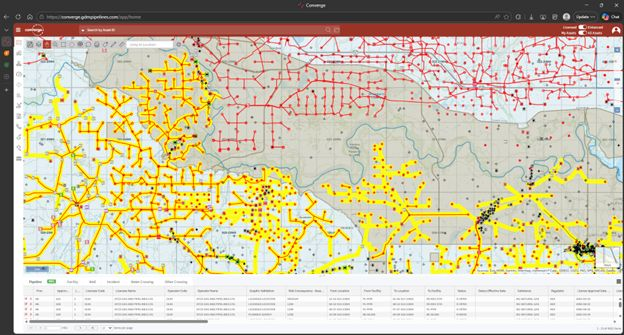
As expectations around infrastructure accountability rise, the Canadian energy industry is being pushed to rethink how risk is defined, validated, and shared. GDM offers operators the tools to eliminate the gap and quantify financial consequences (production loss, cleanup, reclamation, and repair costs) directly within their risk scoring framework with Risk Manager.
Across the energy industry, the pressure on infrastructure decision-making has changed, and risk is the common catalyst. While risk itself isn’t new, it’s always been a connecting thread that links operators, regulators, and communities to energy infrastructure.
Integrity teams must create risk models while navigating fragmented data, disconnected systems, and alternate interpretations of reality. Executives must justify capital allocation in clear financial terms, and municipalities and Indigenous communities need precise, accessible insight into how infrastructure impacts their jurisdictions.
GDM addresses these challenges directly by expanding how risk is quantified, grounding models in actual field data, and aligning stakeholders around a shared, authoritative view of infrastructure, closing gaps that have historically slowed decision-making and increased uncertainty.
“When everyone works from the same authoritative view, conversations shift from reactive to proactive, from fragmented to collaborative,” says GDM President & CEO, Brian Hall. “GDM starts addressing these challenges by bringing financial reality directly into pipeline risk with Business Impact in GDM’s Converge Risk Manager.”
Pipeline risk has been evaluated across environmental, safety, and population dimensions, but has traditionally lacked a direct connection to the financial language used in operational and executive decision-making. This gap forces companies to translate technical risk into financial implications often with delays, inconsistencies, and misaligned risks.
Operators can now use Risk Manager to eliminate the gap and quantify financial consequences (production loss, cleanup, reclamation, and repair costs) directly within their risk scoring framework. These costs are not separate analyses or external calculations but scored alongside existing consequence factors and calibrated to the corporate risk matrix. The result is a single, defensible model that connects technical risk to financial outcomes.
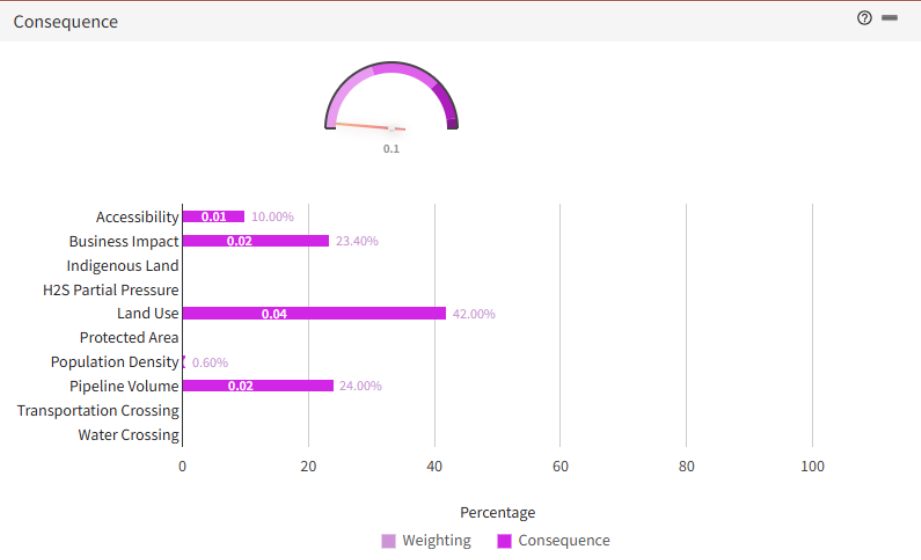
Integrity teams gain a consequence model they can stand behind in front of leadership and regulators. Operations and executives gain clarity on how risk translates into dollars, enabling more informed prioritization of maintenance, inspection, and capital spend.
Crucially, this capability integrates without disruption. Business Impact is turned off by default and activated through the Risk Profile to ensure that existing risk scores remain unchanged until companies are ready to adopt financial consequence scoring.
The release is built for both precision and scale. Users can input four key variables: netback value, cleanup and reclamation cost, repair cost, and downtime duration, to generate calculated outputs such as lost production value and total business impact cost. A Business Impact Modifier then aligns these outputs to the corporate risk matrix, ensuring results fit seamlessly within established governance frameworks.
Visibility is equally comprehensive. Financial consequence data is available at the asset level through a Risk Info page, at the portfolio level through a Risk Dashboard, and can be exported through a Pipeline Risk Report. Whether analyzing a single pipeline or an entire network, companies can access consistent, decision-ready insights.
Just as importantly, organizations retain full control by choosing to either use the current calculated corrosion rate (model or theoretical) or add actual field validated data to make risk scores reflect the reality in the field that is trusted, and defendable.
“Another way of putting real-world evidence at the centre of risk scoring is to apply actual measured corrosion rates derived from in-line inspection or field data,” continues Hall.
Corrosion modeling is the necessary foundation of pipeline risk assessments. Models like de Waard and Milliams (DWM) provide predictive insight based on fluid chemistry but remain theoretical. For operators investing in in-line inspection (ILI), this created a disconnect because real, measured field data was not directly influencing risk scores.
GDM recently introduced Observed Corrosion Rate capabilities for operators to override modelled corrosion rates with measured rates brought forward from ILI or field data. This shift places real data at the risk scoring core, transforming how integrity teams evaluate asset conditions.
The benefit is immediate and tangible with an improvement on risk precision. Risk scores are more accurate on inspected lines, methodologies are defensible under regulatory scrutiny, and investments in inspection programs deliver measurable value beyond compliance.
For organizations operating in the robust and comprehensive regulatory environment within the Canadian energy industry, this represents a meaningful advancement. Risk scores can now be supported by empirical data, not just predictive assumptions.
The implementation is designed with operational realities in mind. Observed corrosion rates are entered pipeline-by-pipeline through a Risk Info page or applied at scale using a Pipeline Export/Import process, making adoption practical.
The updated Pipeline Risk Report adds transparency by clearly distinguishing between model-derived and field-measured corrosion rates. This transparency allows companies to demonstrate how each pipeline’s risk score is derived, strengthening confidence across all stakeholders.
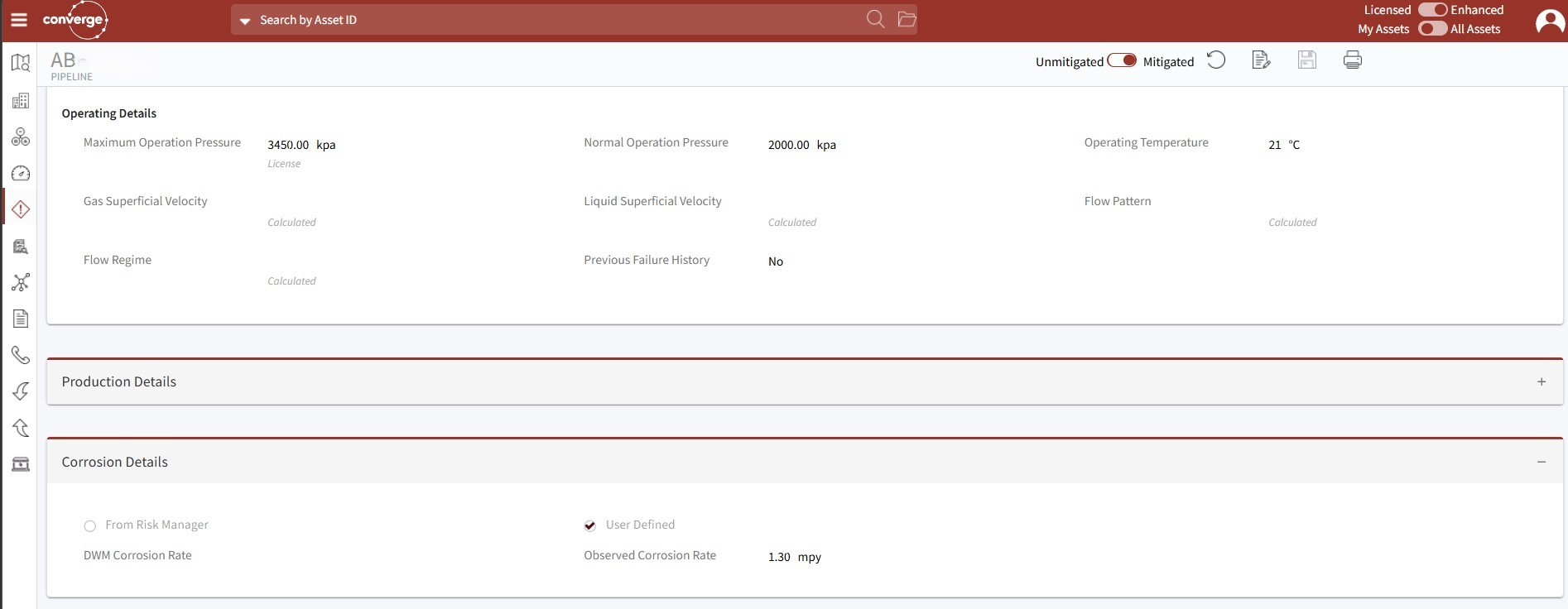
To compliment this functionality the Risk Info page has bee reorganized. Attributes have clearer navigation and improved usability, making it easier for users to access, interpret, and act on critical data without changing underlying functionality. Together, these updates mark a shift toward risk models that are predictive and verifiable.
While risk modeling continues to evolve, a parallel challenge persists across the industry: stakeholders often work from different versions of the truth versus accessing one view shared across all stakeholders.
“Municipalities, Indigenous communities, and operators are being asked harder questions about infrastructure risk, liability, land use, legacy assets, and accountability. The issue isn’t a lack of data, it’s that each stakeholder has historically seen only part of the picture,” Hall says.
GDM’s Municipal and Indigenous Land Area Expansions address this challenge by establishing a shared, authoritative view of infrastructure.
Through boundary-based query capabilities, users can analyze wells, pipelines, facilities, licences, operators, and risk attributes within defined geographic areas. Municipal boundaries, Indigenous lands, rural municipalities, Métis settlements, or custom regions become the common frame of reference.
With a few clicks, stakeholders can access decision-ready data aligned to their specific jurisdiction.
For municipalities, this enables immediate visibility into infrastructure within their boundaries. Users can refine datasets by asset status, such as identifying abandoned wells, export live data, and confidently respond to council inquiries or support land-use planning.
Indigenous communities gain the ability to clearly see how infrastructure intersects with their lands. Pipelines and wells are no longer abstract datasets, but visible, contextualized assets that inform engagement, monitoring, and remediation priorities.
Operators, in turn, gain clarity on their full operational footprint. They can identify where they intersect with municipalities and Indigenous communities, understand asset distribution within those boundaries, and proactively address higher-risk or inactive infrastructure.
This is not just a technical improvement, but also a shift in how decisions are made because the outcome is shared infrastructure intelligence.
“When everyone works from the same map, conversations change from reactive to proactive, and from fragmented to collaborative.”
Taken together, these newly released GDM solutions represent more than incremental improvements. They resolve fundamental industry challenges. In an environment where risk-based decisions must be faster, more defensible, and more transparent, these are not optional capabilities, they are essential.
To see how these new capabilities can strengthen your risk model, aid in your operations, and strengthen decision-making, contact GDM’s integrity expert Francisco Barrera.
About GDM
GDM Inc. is the trusted source for energy infrastructure data in Canada. In business since 1997, GDM is relied on by industry to deliver the most complete, accurate, and current pipeline and facility, environmental incident, transportation infrastructure, utility, and frontier land data. Our data is available as part of prominent industry applications Converge, AccuMap, and geoSCOUT, in addition to being accessible via direct database connections like Snowflake and GIS-ready files.
To round out our offering, our proprietary software application, Converge, offers analytics and mapping tools, as well as modules specific to pipeline risk assessment, water crossing prioritization, and asset connectivity. We also deliver custom data reporting and analytics services to meet the unique and changing needs of the energy industry in Canada.
For more information about GDM’s solutions, visit www.gdm-inc.com

This article is sponsored content, written and paid for by the advertiser. We do not endorse or take responsibility for the accuracy of the information presented. It has not been reviewed by our editorial team, and the opinions expressed are solely those of the sponsor.