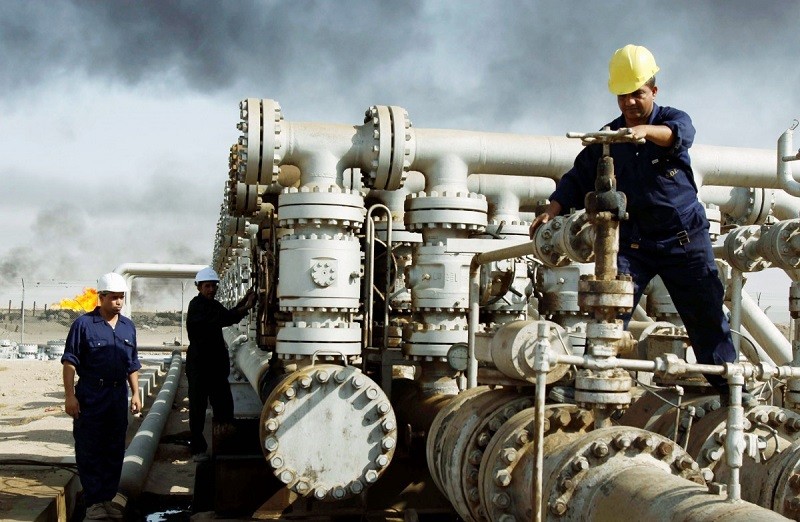
 U.S. President Donald Trump on Thursday said the United States would hit Iran “very hard tonight” and that he wanted to eventually seize Kharg Island, the export heart of one of the world’s largest oil producers.
Following are key facts on Iran’s energy industry:
KHARG ISLAND
The third-largest producer in the Organization of the Petroleum Exporting Countries, Iran exports 90% of its crude via Kharg Island, which sits 16 miles (26 km) from Iran’s coast in the northern end of the Gulf, and about 300 miles (483 km) northwest of the Strait of Hormuz.
Flows from Kharg have been suspended in recent weeks following a U.S. blockade of Iranian oil exports, meaning a move by the U.S. to capture the island would not have an immediate impact on oil shipments.
The U.S. military previously carried out strikes on military targets on Kharg, a U.S official told Reuters in April, but said the strikes did not impact oil infrastructure.
Seizing Kharg would give the U.S. the ability to severely disrupt Iran’s energy trade, but Tehran could opt to lay more mines to target shipping, including floating mines deployed from the coast.
OIL PRODUCTION AND INFRASTRUCTURE
Iran is OPEC’s third largest producer of oil and its fields and facilities are concentrated in the southwestern provinces of Khuzestan for oil, and Bushehr for gas and condensate from the giant offshore South Pars gas field.
Iran pumped 2 million barrels per day of crude oil in May, down from 3 million bpd in April, according to a Reuters survey of OPEC production. That would amount to around 2% of global supply.
Its domestic refineries have a capacity of 2.6 million bpd, according to consultancy FGE. In May, Iran’s crude and condensate exports dropped to their lowest level in at least six years, slipping well below 300,000 bpd, largely due to the U.S. blockade, according to shipping data and analysts. Flows averaged around 209,000 bpd in May, Vortexa data showed, versus 1.34 million bpd in April and nearly 1.9 million bpd in March.
Fuel exports, including LPG, averaged about 820,000 bpd in 2025, according to Kpler, slightly below 2024 levels. Iran’s floating storage in May fell to 147 million barrels from about 190 million in April, Kpler said.
WHO BUYS IRAN’S OIL?
Chinese private refiners are the main buyers. The U.S. Treasury has imposed sanctions on some Chinese refiners for purchasing Iranian oil.
China says it does not recognise unilateral sanctions against its trade partners, but its purchases of Iranian crude have declined. Iran has skirted sanctions for years using tactics including ship-to-ship transfers at sea, masking the origin of its oil, and using tankers that hide their locations from satellites.
Tehran’s demands in its talks with the U.S. include the lifting of sanctions on Iran and recognition of its control of the Strait of Hormuz.
WORLD’S LARGEST GAS RESERVE
Iran produces natural gas from the offshore South Pars gas field, which makes up around a third of the world’s largest reservoir of natural gas.
Strikes have targeted Iran’s production facilities at the South Pars field. Iran restored gas production in May at three offshore platforms in the field that had been forced to halt output.
Iran shares the reservoir with major exporter Qatar, which calls its field the North Dome.
Sanctions and technical constraints have meant most gas Tehran produces from South Pars is for domestic use.
Iran’s gas production totalled 276 billion cubic metres in 2024, with 94% consumed in Iran, according to data by the Gas Exporting Countries Forum.
Israel attacked South Pars last June and this March with fires reported and some disruption to operations.
The entire reservoir contains an estimated 1,800 trillion cubic feet of usable gas – enough to supply the entire world’s needs for 13 years.
(Compiled by Andrew Mills, Federico Maccioni, Dmitry Zhdannikov, Ahmad Ghaddar, Alex Lawler and Stephanie Kelly; editing by Jason Neely)