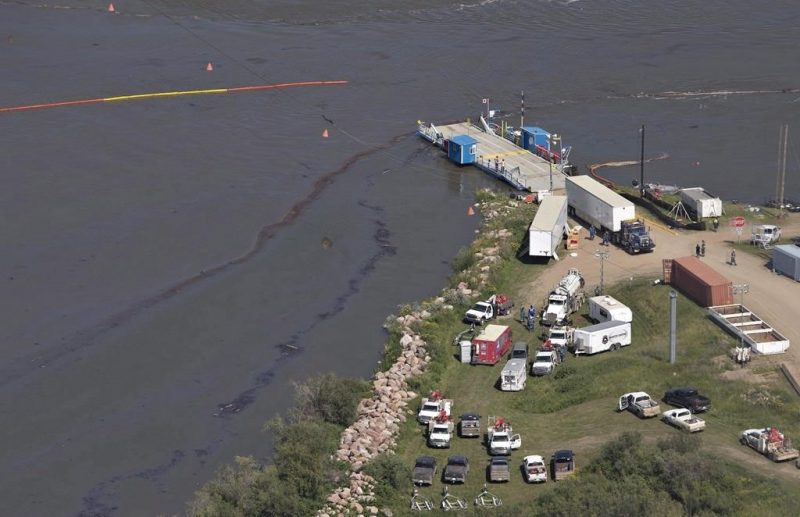
PRINCE ALBERT, Sask. – The Saskatchewan government says the breach that leaked up to 250,000 litres of oil and other material into a river earlier this month has finally been found, but word on what caused it will have to wait.
Laurie Pushor, the deputy minister of the economy, says the section of the Husky Energy (TSX:HSE) pipeline where the spill occurred into the North Saskatchewan River near Maidstone, Sask. on July 20 was dug up Friday.
Pushor says the excavation has now stopped while plans are made to remove the 40-centimetre-wide section without causing a further release of crude oil.
He says once it’s removed, it will be sent for testing.
Pushor says details of the findings, such as what caused the pipeline to fail, will be made when the full report on the incident is made.
The government has said it expects Husky to submit that full report within 90 days of the pipeline breach.
“Specialized equipment is being brought in to purge the pipe and remove the damaged section,” Pushor told a media briefing on Saturday.
“Once the section is removed, it will be sent off for detailed testing and analysis. Additionally, the remaining pipe will be capped and secured,” he continued.
“It is expected this will take several days due to the complexity of the process required to safely execute these next steps.”
The province has estimated that the spill has affected the water supply to about 62,000 people in the area. Municipalities in the region have shut off their water intakes and are relying on other sources, such as stored water in reservoirs or storm retention ponds, to supply their water systems until hydrocarbons in the river flow past.
Prince Albert, a city of approximately 35,000 people that’s downstream from where the breach occurred, hoped to have a 30-kilometre-long temporary water supply pipeline to the South Saskatchewan River running this weekend. A shorter line to the Little Red River was functioning on Saturday, the province said.
Pushor said there were actually two Husky Energy lines that crossed the North Saskatchewan where the breach occurred. One was the 40-centimetre line that carried crude from north to south, and a second line, half the size and running in the opposite direction, carrying a diluent that’s mixed with crude to help the oil move through pipelines.
The lines are underground and Pushor said the breach was discovered on the crude pipeline two to three metres underneath the south riverbank. He explained that the oil travelled from the breach about three or four metres within the outer lining of the pipeline, to the point where it came to the surface about 300 metres from the river’s south shore.
Husky has said it noticed pressure “anomalies” in part of its pipeline on July 20 and detected the spill the following day, when the line was immediately shut down.
Duane McKay, Saskatchewan’s commissioner of emergency management told the news briefing on Saturday the province brought in extra radio equipment to help Prince Albert crews communicate from end-to-end of the 30-kilometre temporary water line.
“I think the pumps are spaced about two kilometres apart and each one has to be started up in sequence, and obviously communications, in startup and shutdown, is absolutely critical,” McKay said.
“Hopefully later today, all pumps will be moving water.”
— By Rob Drinkwater in Edmonton