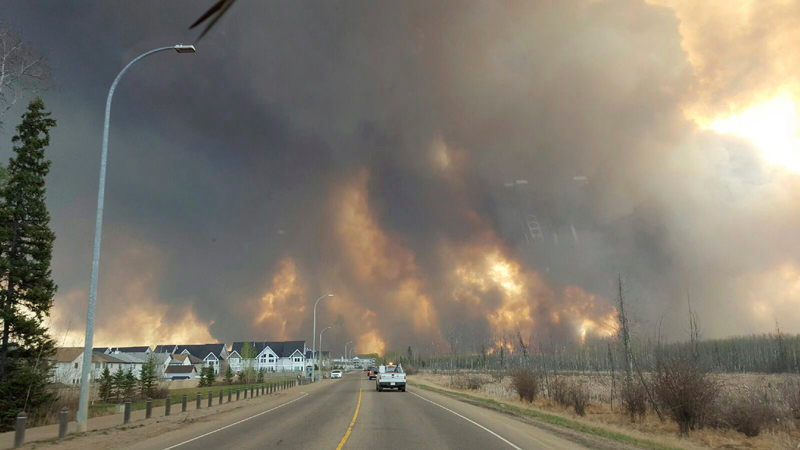
CALGARY – The massive efforts to respond to and rebuild after the wildfire of Fort McMurray, Alta., will spur economic growth in the coming years but leave insurance companies and governments with a tab of more than $5 billion, says a new report.
The Conference Board of Canada said in a paper released Tuesday that the spending will add 0.4 per cent or $1.1 billion to Alberta’s GDP next year, followed by growth of 0.2 per cent and 0.1 per cent in 2018 and 2019, respectively.
The ramp-up in reconstruction, needed to rebuild the nearly 2,000 homes and businesses destroyed by the May fire, is also expected to create about 9,000 jobs next year and cut a 0.1 percentage point off the unemployment rate.
The report concluded that the economic boost from spending on the fire this year will be more than offset by lost oilsands production as companies were forced to shut down operations, shaving off 0.1 per cent or $456 million from Alberta’s GDP.
The Conference Board also warned that while the increased spending in the coming years will boost the GDP, it isn’t suggesting there will be any overall benefit to the disaster.
“We’re really not better off down the road,” said Pedro Antunes, deputy chief economist at the Conference Board in a media call. “There are some negative long-term consequences to this extra rebuilding.”
Antunes said insurance rates will likely go up as companies struggle to cover the costs, while governments will see higher debts.
Bill Adams, vice-president of the Western and Pacific division of the Insurance Bureau of Canada, said insured costs of the fire have now climbed to an estimated $3.77 billion.
“Without diminishing the profound impact this has had on families and this community, the Fort McMurray wildfire has become the largest insured claims event in Canadian history,” said Adams.
The Conference Board based its finding on an earlier insurance estimate of $3.6 billion in payouts, while it found governments will be on the hook for about $1.5 billion in firefighting, relief and rebuilding costs.
Another $200 million came from early payouts from the Alberta government, the Canadian Red Cross and oilsands companies to cover immediate household needs, bringing the report’s total estimated cost of the fire by the end of 2019 to $5.3 billion.
The report says responsibility for covering costs of the fire are in stark contrast to the 2013 Alberta floods, where provincial and federal governments took a $3-billion loss compared with $1.8 billion for insurers because of a general lack of flood insurance.
The report also says that while governments will see a boost in personal income and sales taxes, corporate income tax over the next three years will overall be lower than what the Conference Board had forecasted before the fire because of foregone revenues from oil companies.
Besides forcing the evacuation of close to 90,000 residents from the Fort McMurray area, the fire also resulted in major oilsands operations losing 47 million barrels in production and $1.4 billion in potential revenue.
The Conference Board said this year’s shortfall in oil production means Alberta will see an overall $25 million loss in royalties and a $58 million reduction in corporate income tax between 2016 and 2019, while increased personal and indirect taxes will offset that for an overall $41 million increase in tax revenue.
Follow @ibickis on Twitter.